





Bridging Nations, Building Knowledge: Research for Mutual Prosperity
Overview
Welcome to the Sino–Thai Research Unit (STRU)
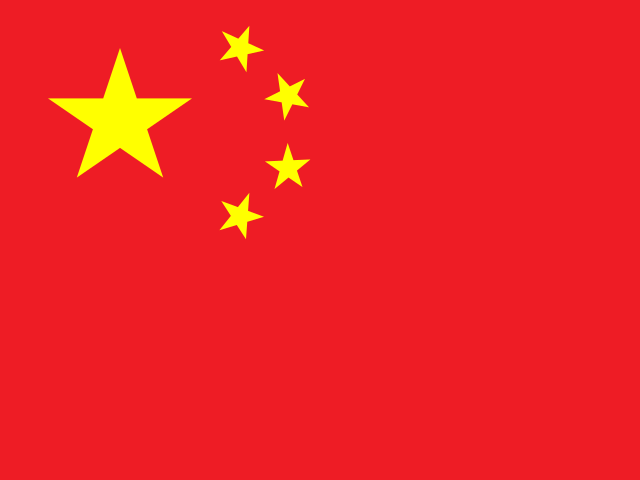
The STRU is a dedicated bilateral platform established to foster high-impact collaborative research between the Kingdom of Thailand and the People’s Republic of China. Recognizing the deep-rooted diplomatic and economic ties between our nations, the Unit moves beyond traditional cooperation by transforming joint research into actionable strategies for shared progress.
Our mission is to serve as a neutral, academic, and policy-oriented bridge—connecting Thai and Chinese universities, think tanks, industry leaders, and government bodies.
Our Objective
What We Aim to Achieve
The primary objective of the Sino-Thai Research Unit is to promote, facilitate, and disseminate bilateral research that directly benefits both nations. We believe that evidence-based insights lead to better decisions — and better opportunities.
Our core objectives include:
1. Facilitate Joint Studies
Connecting researchers from Thailand and China to co-lead projects across trade, economics, policy, technology, and social sciences.
2. Inform Policy & Governance
Providing data-driven recommendations to policymakers in trade, economy, and regulation to support sustainable bilateral cooperation.
3. Drive Innovation & Technology Transfer
Translating joint research in fields such as EV manufacturing, AI, agriculture tech, and digital infrastructure into real-world applications.
4. Commercialize Research Outputs
Actively identifying, protecting, and commercializing intellectual property arising from bilateral research. This includes:
- Filing patents and utility models jointly held by Thai and Chinese institutions.
- Licensing research-backed technologies to private sector companies in both countries.
- Creating spin-off or joint ventures that manufacture or deploy solutions developed through STRU-backed projects.
5. Sell Products & Services Derived from Research
Moving beyond publications to market-facing outcomes. STRU will support:
- Go-to-market strategies for research-born products
- Cross-border e-commerce and distribution channels for Thai–Chinese co-developed goods.
- Service commercialization: offering certification, testing, consulting, or training packages based on validated research.
6. Ensure Mutual Economic Benefit
Every research project with commercial potential is structured so that both Thai and Chinese entities share in revenues, royalties, or market access — ensuring that commercialization strengthens, rather than exploits, bilateral trust.
Key Research Topics
Areas of Focus
Our work is structured around four interdependent pillars that define the Thailand-China relationship:
1. Trade & Supply Chains
- Cross-border e-commerce trends
- Logistics corridors (Land, rail, and maritime links)
- Tariff and non-tariff barrier analysis
- Agricultural trade optimization
2. Economics & Finance
- Regional investment flows (BRI & post-BRI era)
- Currency settlement mechanisms (Bilateral local currency trading)
- SME financing and cross-border capital markets
- Tourism economics recovery models
3. Policy & Governance
- Comparative public policy analysis
- Environmental regulation alignment
- Digital governance and data privacy laws
- Labor mobility and skills recognition frameworks
4. Technology & Social Dynamics
- Technology transfer in EV manufacturing and smart electronics
- Digital infrastructure (5G, AI, Smart Cities)
- Cross-cultural communication and education exchange
- Social impact of migration and urbanization
The “For the Benefit of Both” Approach
How We Ensure Dual Benefits
A unique feature of the Sino-Thai Research Unit is our reciprocity framework. Every research project must answer one question: “How does this outcome serve Thailand AND China?”
- For Thailand: Access to advanced Chinese technological methodologies, large-scale data analytics, and manufacturing scaling insights.
- For China: Access to Thai expertise in ASEAN market dynamics, agricultural resilience, tourism management, and cultural linguistics.
By embedding both nations’ researchers from the design phase, we eliminate bias and produce outputs that are implementable in Bangkok, Beijing, and beyond.